
Giorgione (Giorgio de Castelfranco). Portrait of a Man (‘Terris Portrait’), 1506. Oil on panel. The San Diego Museum of Art. Gift of Anne R. and Amy Putnam. 1941.100. During the late Renaissance, Venice replaced Florence as Italy’s most celebrated art capital. “In the Age of Giorgione” at London’s Royal Academy of Arts explores how this came about thanks to two local talents, Giorgione and Titian (March 12 to June 5). Organized thematically, the focused survey begins with two galleries of portraits, followed by landscapes and religious paintings. Rare masterpieces by Giorgione are displayed alongside early works by his younger colleague and rival Titian, and two paintings by their teacher, Giovanni Bellini. After Giorgione’s untimely death, it was Titian who put Venice on the map. In his Lives of the Artists, Giorgio Vasari describes Giorgione as “extremely fond of the lute” and “a very amorous man.” Little else is known about this enigmatic figure, whose life was Read More
Hubert Robert: a Visionary Painter

Elisabeth Louise Vigée-Le Brun, Hubert Robert. 1788. Oil on oak panel. H. 105; l. 84 cm. Musée du Louvre © RMN - Grand Palais / Jean-Gilles Berizzi Though French artist Hubert Robert’s name doesn’t resonate like those of his compatriots Chardin and Fragonard, in his day he was celebrated for his poetic views of architectural ruins. Robert’s diverse fans ranged from Louis XVI and Catherine the Great to Voltaire and Thomas Jefferson. Co-organized by the Louvre and National Gallery of Art, “Hubert Robert: a Visionary Painter” reintroduces this 18th century artist with some 140 works -- beautiful red chalk drawings, painted sketches, engravings, capricci, large paintings, and decorative and garden designs (Louvre, Paris; March 9 to May 30; National Gallery of Art, Washington, D.C.; June 26 to October 2). “The feeling and the conviction is that Hubert Robert is much more than just “Robert of the Ruins,” says exhibition curator Guillaume Faroult of the Louvre’s Read More
Vigée Le Brun: Woman Artist in Revolutionary France

“Only in painting have I found happiness,” Elisabeth Vigée Le Brun confided at the end of her long, prolific career. Though Vigée Le Brun’s high society portraits earned her great fame during her lifetime, her sentimental style fell out of fashion and she largely dropped off the radar. Her long overdue retrospective, “Vigée Le Brun: Woman Artist in Revolutionary France” opens at the Metropolitan Museum of Art in New York (February 15 to May 15, 2016). Organized at the Met by Katharine Baetjer, curator in the department of European paintings, the exhibition follows Vigée Le Brun’s singular career chronologically -- from Paris to her peripatetic years as an émigré artist and return to France. According to Baetjer, preparation for the exhibition confirmed Vigée Le Brun’s technical skills. “Her works on both canvas and panel are exceptionally well preserved and, as far as one can know, seem to look much as they did when they were painted.” We first meet the artist in a terracotta Read More
Konstantin Makovsky: The Tsar’s Painter

In the late 19th century, traditional Russian culture enjoyed a revival. Among the artists to reimagine his country’s idealized past was Konstantin Makovsky, the subject of a new monograph survey at Hillwood Estate, Museum & Gardens in Washington, D.C. (February 13 to June 12). Organized by Wilfried Zeisler, Hillwood’s associate curator of nineteenth-century art, Wendy Salmond, professor of art and art history at Chapman University and Russell E. Martin, professor of history at Westminster College, “Konstantin Makovsky: The Tsar’s Painter” explores the artist’s career and popularity in Russia and America. The Moscow-born son of an amateur painter and a composer, Makovsky briefly joined the Wanderers, a group of social realists who left St. Petersburg’s Academy of Arts. Choosing security, he became a professor at the Academy and launched a successful career with his flattering portraits of Russian high society. After the death of his first wife, Makovsky traveled to Egypt Read More
Sublime Beauty: Raphael’s Portrait of a Lady With a Unicorn
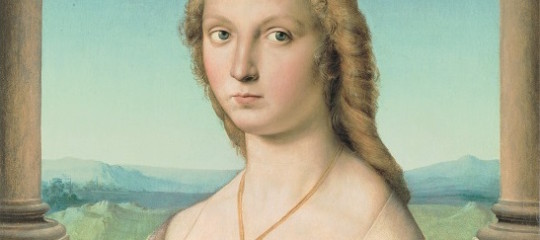
For centuries, an unsigned portrait of a beautiful young woman at Rome's Galleria Borghese remained shrouded in mystery. Now a focus exhibition at San Francisco's Legion of Honor, Sublime Beauty: Raphael's "Portrait of a Lady with a Unicorn" brings the enigmatic teenager to the U.S. for the first time with a new theory about her identity (January 9 to April 10). "Inexplicably magnetic, it stops you in its tracks," says Esther Bell, the show's organizer and curator of European Painting at the Fine Arts Museums of San Francisco. "It's a beautifully balanced painting and one of Raphael's most beautiful portraits." First recorded in the Borghese collection in 1682, "Portrait of a Lady with a Unicorn" was misattributed to a number of artists, including Pietro Perugino and Domenico Ghirlandaio. Further clouding matters, in the mid-17th century, an unknown artist changed the sitter into St. Catherine, covering her bare shoulders with a cloak and replacing the small unicorn in her lap Read More
Woven Gold: Tapestries of Louis XIV

One of the first things seven-year-old Louis XIV did as France's King was to give away a set of exquisite medieval tapestries. As an adult, the Sun King wouldn't make the same mistake. During his 72-year-reign, Louis XIV amassed history's largest tapestry collection, a staggering 2,650 plus pieces. Only England's Henry VIII came close. To mark the 300th anniversary of Louis' death, fifteen of his treasures unfurl for "Woven Gold: Tapestries of Louis XIV" at the J. Paul Getty Museum in Los Angeles (December 15 through May 1, 2016). Most of the tapestries have traveled from Paris's Mobilier National, repository for 600 of the roughly 700 surviving pieces of the royal collection. Located in Paris's 13th arrondissement, the little-known institution furnishes the Élysée Palace, ministries, and embassies. Created in weaving workshops across northern Europe, the featured tapestries date from about 1540 to 1715. Eleven are making their U.S. debut; two recently underwent conservation Read More
Catherine the Great: “Glutton” or Connoisseur?

After wresting power from her husband, Catherine the Great ruled Russia for 34 years, styling herself as the heir to her westernizing grandfather-in-law Peter the Great. In parallel with military campaigns that added large parts of Poland and the Crimean Peninsula to Russia's Empire, the German-born Tsarina waged a cultural offensive, buying Western art by the boatload. The Hermitage Museum, the Winter Palace in Summer, from across the Neva River, St Petersburg Photo: Andrey Terebenin With her first acquisition in 1764 -- some 300 canvases earmarked for political rival Frederick the Great of Prussia -- Catherine II founded the State Hermitage Museum in St. Petersburg. On the heels of the museum's 250th birthday, over 450 of her art works star in "Masterpieces of the Hermitage: The Legacy of Catherine the Great" at the National Gallery of Victoria in Melbourne, Australia through November 8. Organized by Mikhail Dedinkin, deputy head of the Hermitage's department of Western Read More
A Donatello Restored
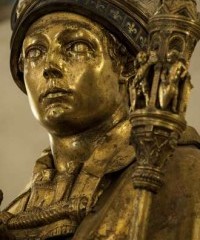
Sculpture’s key role in the Florentine Renaissance is the theme of “The Springtime of the Renaissance: Sculpture and the Arts in Florence 1400-1460” at Palazzo Strozzi in Florence through August 18 and the Louvre in Paris (September 26, 2013 to January 6, 2014). One of the show’s highlights is an early bronze by Florence’s Donatello, Saint Louis of Toulouse, which recently underwent extensive restoration. The larger-than-life statue was commissioned by the Guelph party as a tribute to the figure who renounced his claim to rule Naples to become a Franciscan. Louis died at 23 and Donatello depicts him with delicate boyish features in bishop’s regalia holding a putti-adorned crosier in his left hand and giving a blessing with his right. Enamel, rock crystal and fleurs-de-lis decorate his mitre. Donatello created the figure for the eastern wall of the church of Orsanmichele where both the sun and a classically inspired marble and gold niche added to its brilliance. But with the Guelph Read More
Theatre of the World: Vienna’s New Chamber of Art

Saliera, Benvenuto Cellini, 1540-43, gold, enamel ©Wien, Kunsthistorisches Museum During the late 16th century, Holy Roman Emperor Rudolf II turned Prague into Europe’s cultural capital, amassing the greatest art collection of his day. Cost was no object and he invited the best goldsmiths, stone carvers, and clock makers to his court. Rudolf kept the treasures inside Hradcany Castle in a chamber of art, or Kunstkammer, a highly personal reflection of his world view. Today, Rudolf’s prized possessions along with those of his art-loving Habsburg relatives reside at the Kunsthistorisches Museum in Vienna. After a decade long closure, the museum’s refurbished Kunstkammer reopened March 1. Though the museum itself is lavishly decorated by famous artists including Gustav Klimt, and crowned with an ornate cupola, nothing prepares you for this 20-room embarrassment of riches. The “museum within a museum” features a dizzying 2,200 objects arranged chronologically -- from the late Read More
Chagall in 3D

Model for the curtain "The Firebird", The Enchanted Forest, 1945, Private collection, © Archives Marc et Ida Chagall. © 2012 Artists Rights Society (ARS), New York/ADAGP, Paris In the 1950s Picasso said, “When Matisse dies, Chagall will be the only painter left who understands what color really is.” Famous for his colorful paintings of floating figures and flying animals, Russian-born artist Marc Chagall also worked in other mediums. It’s these lesser-known aspects of the artist’s practice that areexplored in “Chagall: Beyond Color” at the Dallas Museum of Art from February 17 to May 26, 2013. Costumes, ceramics, and sculptures are arranged chronologically -- from Chagall’s formative years in Russia and Paris, wartime exile in the United States, and post-war return to France. Visitors may recognize in the white marbles, terra cottas, and silk ballet costumes familiar people and animals from his much loved paintings. The eldest of nine children in a poor Hasidic family Read More